Ancient City of Ephesus
Harbour Baths and Halls of Verulanus
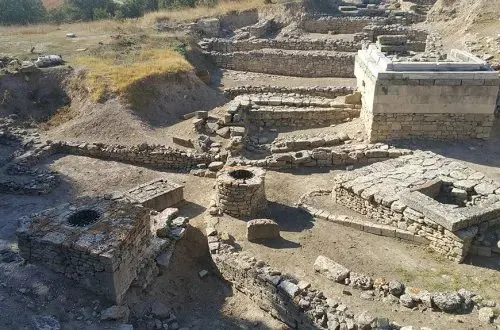
The Harbour Baths form a large bath-gymnasium complex located north of the Arcadian Way (Arkadiane). Laid out on a west–east axis, it consists of three parts: the baths, the gymnasium and the sports ground. Construction began in the reign of Domitian and was completed in the 4th century AD. The complex is entered from the Arcadian Way through a gateway with three openings. Directly opposite the entrance, on the south side, is an exedra decorated with statues.
The baths section begins with a 45-metre entrance hall in front of the entrance, surrounded on three sides by a mosaic-paved peristyle. A staircase between two spiral columns on the north side leads into a hall, where an inscription reads "Atrium thermarum Constantianarum". In the same area, bull heads and garlands can be seen above a fountain. The atrium on the gate side has the appearance of a three-aisled hall, and its outer walls are supported by brick piers, with arches between the niches. Archaeological finds indicate that the atrium was also used as a place of sale. The atrium gives access to the baths section to the north.
The baths are laid out symmetrically and include the classic rooms: the apodyterium, frigidarium, natatio, tepidarium and caldarium. The heating systems (hypocaust) beneath the floors and within the walls are particularly noteworthy. There were also additional facilities such as rooms for ball games, boxing, gymnastics, massage, skin care and cosmetics.
In antiquity the gymnasium section was probably known as the "Imperial Gymnasium". In this 90-metre-long section, two rooms on the north and south sides served as lecture halls for the cultural and spiritual education of young people. Many statues were found in the marble-clad hall on the south side, which is therefore thought to have been used as an imperial hall. An inscription from the building records that it was built by Tib. Claudius Aristion of Ephesus in honour of Emperor Domitian. A bronze statue of an athlete found in this hall is now on display in the museum in Vienna.
From the central part of the gymnasium, an entrance with two rows of four columns leads to the sports ground, which measures 200 × 240 metres. In antiquity this huge sports ground was called the "Xystoi". The three rows of columns surrounding it created the effect of three aisles: the two side aisles were roofed, while the central one was open and may have been used as a running track. In the reign of Emperor Hadrian, the walls of the Xystoi were faced with marble slabs by the imperial priest Claudius Verulanus, which is why this area is known as the "Halls of Verulanus". The structure itself, however, was built earlier.