Ancient City of Ephesus
Trajan's Fountain
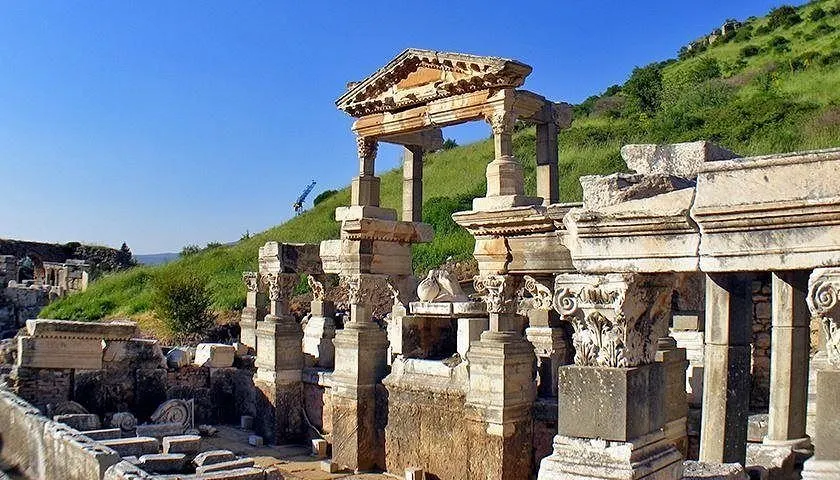
The Ancient City of Ephesus is a fascinating destination, rich in the history and architectural heritage of the Roman Empire. Among its monuments, Trajan's Fountain stands out as an important structure reflecting the splendour and technical mastery of the empire.
Trajan's Fountain was built between AD 102 and 114 by Tiberius Claudius Aristion and dedicated to the Roman emperor Trajan. Symbolising the emperor's victories and the power of Rome, the fountain also played an important role in meeting the city's water needs. It stands on Curetes Street in Ephesus.
The fountain's most striking feature was the statue of Emperor Trajan on its upper level. The statue stood in a large niche at the centre of the fountain, showing the emperor standing on a pedestal. Although only the emperor's right foot survives today, these details emphasise the respect and honour the fountain paid to his reign.
The fountain's pool measures 20 × 10 metres, and its edges were once decorated with columns and statues. Statues of Dionysus, a satyr, Aphrodite and members of the imperial family stood around the pool. Some of these statues are now on display in the Ephesus Museum and are an important resource for exploring the art and mythological figures of antiquity.
On Domitian Square, the Pillars of Hercules placed at the eastern exit of Curetes Street narrow the roadway. These pillars are decorated with details such as Hercules carrying the head of a lion, and they are tall enough to be seen from the far end of the street.